
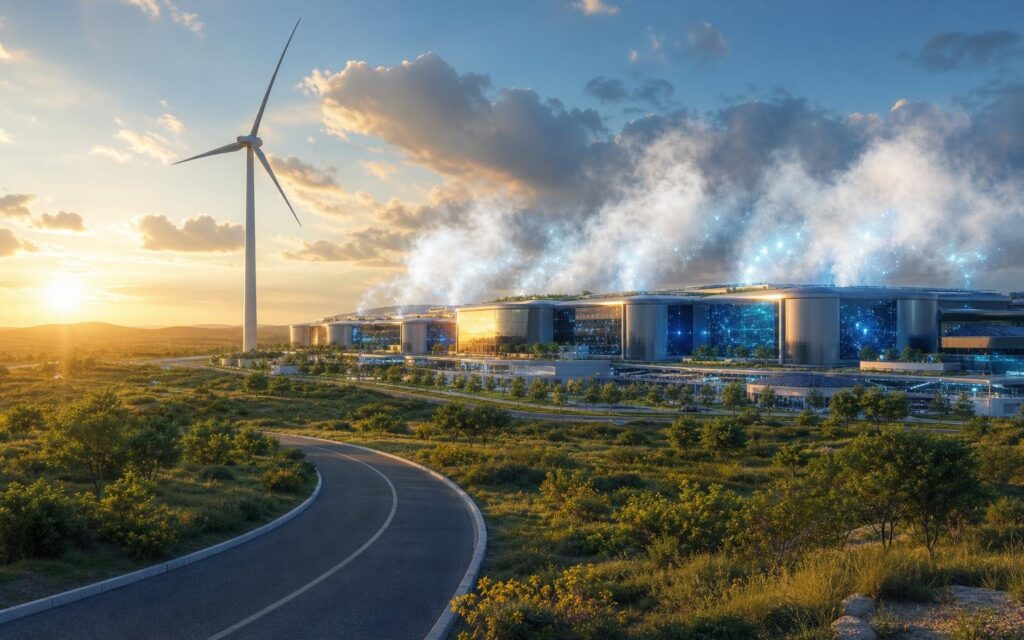
Hut8 Corp (Nasdaq, TSX: HUT) doesn’t look much like the bitcoin miner that landed on Nasdaq a few years back. It calls itself an energy infrastructure platform now, and the label isn’t just marketing copy. The company develops, finances and operates power and data-center capacity that serves both crypto mining and, increasingly, artificial intelligence workloads. Shares recently changed hands near $91, putting the market cap around $10.3 billion, well off the 52-week high of $140.80 but nowhere near the $18.68 low the stock touched a year ago. Second-quarter results land August 4.
This is an inventory, not a pitch. Here’s what’s actually happened at Hut8 over the last several months, and why some of it matters more than the headlines suggested at the time.
Recent operational developments
The biggest structural change is that Hut8 no longer runs bitcoin mining as a core, consolidated business. It spun the operation into American Bitcoin Corp in 2025, and this year ABTC merged with Gryphon Digital Mining and began trading on Nasdaq under the ticker ABTC. Hut8 kept a majority stake but stopped carrying the day-to-day mining economics on its own books. The subsidiary hasn’t had an easy run as a public company: it executed a 1-for-15 reverse split on July 2 just to stay above Nasdaq’s minimum bid-price threshold, cutting its share count from roughly 1.09 billion to about 73 million.
Meanwhile the parent company’s real news has been happening in data centers. Hut8 said in May it had commercialized the first phase of its Beacon Point campus in Texas, a site planned for 1 gigawatt eventually, signing a 15-year, 352-megawatt IT lease worth $9.8 billion over the base term. Management said working with its lease partner let it push capacity from an originally planned 224 MW to 352 MW on the same land and utility footprint, adding $3.6 billion in potential contract value.
Beacon Point followed the template set at River Bend, Hut8’s 330 MW campus in West Feliciana Parish, Louisiana. In December 2025 the company signed a 15-year, 245 MW lease there with Fluidstack for AI workloads tied to Anthropic, worth roughly $7 billion and backed by a financial guarantee from Google covering the full lease term. That guarantee matters more than it sounds on first read: it converts what would otherwise be Hut8’s counterparty risk into Google’s credit risk, a meaningfully different thing for lenders to underwrite. First capacity at River Bend is expected online by early 2027.
Combined, River Bend and Beacon Point now represent about 597 MW of contracted AI capacity and roughly $16.8 billion in base-term value, a figure that could rise to $25.1 billion if renewal options get exercised down the line.
On the power side, Hut8 keeps trimming what doesn’t fit. It sold its Far North power-generation joint venture in February for a $33.6 million gain, and refinanced a bitcoin-mining credit facility, lowering its cost of debt and freeing up roughly 3,300 bitcoin previously pledged as collateral. As of its May update, the company reported 710 MW of power under management and a development pipeline of 8,375 MW across sites in Louisiana, Texas, Illinois and elsewhere.
Recent corporate and financial developments
First-quarter 2026 revenue came in at $71.0 million, up 226% year over year, with the compute segment (bitcoin mining, GPU-as-a-service, data-center cloud) contributing $66.0 million of that. Gross margin jumped to 64% from 14% a year earlier. None of that stopped Hut8 from posting a net loss of $253.1 million, driven mostly by $295.7 million in largely unrealized mark-to-market losses on its bitcoin holdings. Adjusted EBITDA was negative $250.5 million, worse than the negative $117.7 million logged a year earlier, and per-share results missed analyst estimates by a wide margin. The company closed the quarter with $160 million in cash plus roughly 16,331 bitcoin carried at about $1.11 billion, for combined liquidity near $1.3 billion.
What’s more interesting than the loss itself is how Hut8 is funding its buildout. In June, a subsidiary closed a $4.25 billion offering of investment-grade senior secured notes for the Beacon Point project, priced at 6.129% and rated Baa2 by Moody’s, one notch above the BBB- that S&P and Fitch had assigned to the River Bend financing months earlier. The deal was oversubscribed and priced 20 basis points tighter than River Bend’s notes, pushing cumulative project-level investment-grade financing across the two campuses to $7.5 billion. J.P. Morgan led the offering; Goldman Sachs also acted as a bookrunner. Hut8 says both financings are non-recourse to the parent and non-dilutive to shareholders, with debt sitting against each project’s lease cash flows rather than the corporate balance sheet.
Leadership changed hands too. At the June 11 annual meeting, shareholders elected E. Stanley O’Neal, former chairman and CEO of Merrill Lynch and a Hut8 independent director since 2023, as the new board chair, succeeding founding chair William Tai. Tai stays on as a director and on the Nominating and Governance Committee. The company has also pointed to a sharp rise in institutional ownership over the past two years, though it hasn’t broken out which funds are driving that shift in any recent disclosure.
Industry context
None of this is happening in a vacuum. Bitcoin’s network hashrate, which peaked near 1,154 exahashes per second last October, had slid to roughly 908 to 918 EH/s by mid-July. Mining difficulty followed it down, falling to 127.17 trillion on July 11 in the network’s 14th adjustment of the year, a decline of about 14% since January. Hashprice, the standard gauge of expected miner revenue per unit of computing power, recovered some ground to around $31 per petahash per day but remains more than a third below its October peak. Bitcoin itself was trading near $62,000 in mid-July, down roughly 29% year to date. Mining margins across the industry have been squeezed hard by that combination, which is a big part of why so many public miners have gone looking for AI and HPC revenue that doesn’t move with the block reward.
Why the AI pivot, and the crypto business alongside it, is a genuine long-term positive
Start with the physical reason this works. Building an AI data center from scratch takes years of utility queues, transmission upgrades and permitting before a single GPU gets plugged in, often 36 months or longer by industry estimates. Hut8’s sites, built for bitcoin mining, already carry grid interconnection rights and substations sized for continuous, industrial power draw. Converting that into AI-ready colocation is a matter of quarters, not years, because the hardest part is already done. That’s why River Bend and Beacon Point both landed signed hyperscale leases well ahead of their formal energization dates.
The financial logic follows. Bitcoin mining revenue moves with coin price and the difficulty adjustment, and this year’s swings show how rough that ride can be. The AI leases at both campuses run 15 years on triple-net, take-or-pay terms, so Hut8 gets paid whether or not the tenant fully utilizes the capacity. Stack enough of that on top of mining and earnings volatility should decline over time — not because mining gets safer, but because it becomes a smaller slice of a larger, steadier whole.
The demand isn’t speculative dressing. CoinShares put cumulative AI/HPC contracts across public miners above $70 billion in its Q1 2026 report, and S&P Global Market Intelligence projects HPC revenue could reach roughly 70% of total revenue for several transformed miners by year-end. IREN’s Microsoft partnership is reportedly worth close to $1.94 billion in annualized revenue. TeraWulf signed over 200 MW with Fluidstack backed by a $1.8 billion Google guarantee. Core Scientific has about 590 MW under contract with CoreWeave. Hut8 sits inside that trend, not apart from it, which is itself evidence that hyperscalers pay premium rates for power-ready sites regardless of which miner owns them.
None of it requires abandoning mining. Hut8 still holds bitcoin and a majority stake in American Bitcoin. The pivot is additive: the same substations and land now serve two demand curves, and management can lean toward whichever pays better at a given site and moment. That’s structural, not a bet on one market beating the other.
It’s also not guaranteed. VanEck estimates the sector faces a roughly $50 billion near-term funding gap and up to $221 billion in long-term capital needs, and by its count only about a quarter of announced AI/HPC capacity has actually been energized into billable revenue. Hut8’s own record here is short: River Bend’s first phase isn’t due online until early 2027, and a meaningful share of its future economics rests on two relationships, Fluidstack and Anthropic, rather than a broad tenant base. Transformer and switchgear lead times remain a real bottleneck industry-wide. Announced megawatts aren’t delivered megawatts.
Closing
The next checkpoints are concrete and dated: River Bend’s initial capacity online in the second quarter of 2027, the broader Anthropic-Fluidstack buildout on a similar timeline, and an August 4 earnings report that should show whether construction and lease revenue are tracking to plan. Two years ago Hut8 was, for practical purposes, a bitcoin-price derivative with a Nasdaq ticker. It isn’t that anymore. What it is instead — a power-first infrastructure developer with shrinking mining exposure and a growing contracted-lease business — is still being built, literally, one substation at a time.
—————————————————————————————————————————————
Disclosure: This article is for educational purposes only and does not constitute investment advice. Investors should conduct their own due diligence and consult a qualified financial professional before making investment decisions.
Sources
Hut8 Corp. press releases and SEC/SEDAR+ filings; PR Newswire; StockTitan; Investing.com; Yahoo Finance; Morningstar; TradingView; Quartr; Bitbo; Entergy; Louisiana Economic Development; Hashrate Index; Bitcoin.com News; CoinShares Q1 2026 Mining Report; S&P Global Market Intelligence; VanEck research; Stocktwits.