
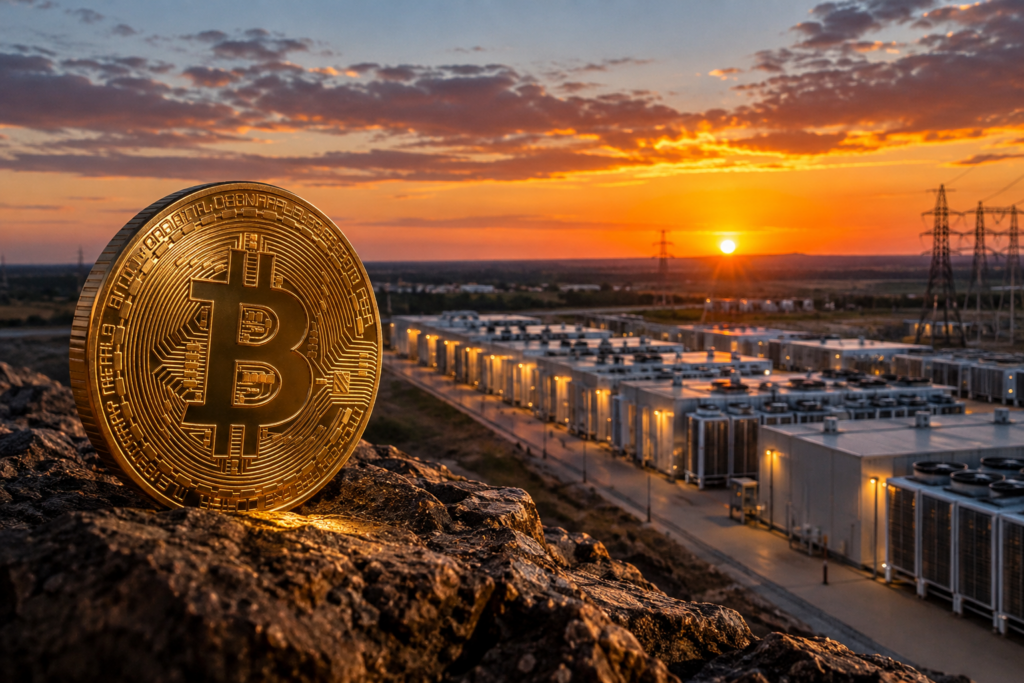
Riot Platforms (NASDAQ: RIOT) has traditionally been known as one of America’s largest publicly traded Bitcoin miners. But that description is becoming increasingly incomplete.
During 2026, Riot has begun demonstrating that the enormous power infrastructure originally assembled for Bitcoin mining can also support another rapidly growing industry: artificial intelligence and high-performance computing data centers.
The result is a potentially important transformation.
Instead of depending almost entirely on Bitcoin mining economics, Riot is developing a business that combines Bitcoin mining, AI infrastructure, long-term data-center leases, power assets, engineering capabilities and large-scale real estate.
For investors looking several years into the future, this diversification is a major reason Riot could continue delivering.
Riot’s AI Strategy Is Becoming Real
For some Bitcoin miners, AI has remained mostly a future possibility. Riot has moved beyond that stage.
In January 2026, Riot announced its first major data-center agreement with Advanced Micro Devices (AMD). The original agreement covered 25 MW of critical IT capacity at Riot’s Rockdale, Texas campus.
AMD subsequently exercised an additional 25 MW expansion, bringing its contracted capacity to 50 MW.
Riot delivered the initial 25 MW on time and on budget, with construction underway on the additional 25 MW as of its second-quarter results.
That execution is important.
Signing an AI infrastructure agreement creates a good headline. Actually building and delivering the infrastructure demonstrates that Riot can operate as a data-center developer.
Then Came a Much Bigger Deal
Riot’s second major agreement dramatically increased the scale of its data-center ambitions.
In August 2026, Riot announced a 20-year lease for 191 MW of critical IT capacity at Rockdale with what the company describes as a leading frontier AI laboratory.
Riot expects the initial 20-year agreement to generate approximately $9.1 billion in total contract revenue.
If the tenant exercises two additional five-year extension options, Riot estimates potential contract revenue could reach approximately $16.1 billion.
Even more interesting is the projected operating income.
Riot estimates the base lease could produce cumulative net operating income of approximately $7.3 billion to $8.2 billion, equivalent to roughly $365 million to $411 million in average annual NOI.
That represents an enormous potential new source of earnings for a company historically associated with Bitcoin mining.
Riot Now Has 241 MW Contracted
Combined with AMD, Riot now has 241 MW of contracted critical IT capacity at Rockdale.
The company says the two agreements represent approximately $9.8 billion of long-term contracted revenue.
This changes the Riot investment thesis.
The company is no longer simply saying:
“We have power that could someday be used for AI.”
It is signing long-duration contracts and beginning to generate data-center revenue from that infrastructure.
That’s an important distinction.
The Existing Power Portfolio Is the Real Asset
Riot’s most valuable long-term competitive advantage may not ultimately be its Bitcoin miners.
It may be electricity.
Riot reports approximately 2.0 GW of fully approved power across its infrastructure footprint. Its two major Texas campuses are particularly important. Rockdale has approximately 700 MW of capacity, while Corsicana has approximately 1 GW.
Securing huge amounts of power isn’t easy.
AI data centers require enormous amounts of electricity, and bringing new generation, transmission and interconnection capacity online can take years. The International Energy Agency estimates that grid constraints could delay around 20% of global data-center capacity planned for construction through 2030, underscoring the value of sites with existing access to large amounts of power.
Riot already controls large sites with power infrastructure.
That potentially gives the company something extremely valuable in the AI infrastructure race: speed to market.
Corsicana Could Be the Next Major Catalyst
Rockdale demonstrates what Riot can accomplish with existing infrastructure.
Corsicana could potentially take the strategy much further.
Riot’s Corsicana campus encompasses approximately 958 acres with 1 GW of total planned capacity and a direct 345 kV transmission interconnection. The company is developing a 168 MW core-and-shell building designed for high-density AI and HPC workloads.
Riot’s Q2 2026 presentation also reported that the full Corsicana site was under a non-binding letter of intent with a single tenant. Because an LOI isn’t a completed lease, investors shouldn’t count that prospective business as contracted revenue yet.
But the opportunity demonstrates the scale of Riot’s available infrastructure.
If Riot can reproduce the leasing success achieved at Rockdale across Corsicana, its data-center business could become much larger.
Bitcoin Mining Isn’t Going Away
The AI opportunity doesn’t mean Riot needs to abandon Bitcoin.
During Q2 2026, Riot produced 1,587 Bitcoin, compared with 1,426 during the same period in 2025.
Bitcoin mining generated approximately $113.7 million of quarterly revenue.
That gives Riot an unusual dual-engine business model.
Engine #1: Bitcoin
Riot maintains substantial Bitcoin mining infrastructure and therefore exposure to potential appreciation in Bitcoin.
Engine #2: AI Infrastructure
Riot can convert portions of its power and real-estate portfolio toward long-duration data-center contracts.
The combination is interesting because these businesses have very different economic characteristics.
Bitcoin mining provides potentially substantial upside but can be volatile.
Long-term data-center leases potentially provide more predictable contractual revenue.
If Riot executes successfully, one business could complement the other.
Riot’s Balance Sheet Gives It Flexibility
Large-scale data-center construction requires enormous amounts of capital, making Riot’s liquidity another important part of the thesis.
At June 30, 2026, Riot reported more than $1.2 billion of liquid assets, consisting of approximately $549 million in cash and Bitcoin worth approximately $666 million at the quarter-end Bitcoin price.
Riot has also arranged a $573 million interim financing facility from Morgan Stanley for the 191 MW Rockdale development while an investment-grade credit backstop is finalized.
Access to financing will remain critical because building hundreds of megawatts of AI infrastructure is capital intensive.
Investors should therefore watch not only how quickly Riot grows, but also how that growth is financed and how much shareholder dilution occurs along the way.
Vertical Integration Could Become Another Advantage
Riot has another characteristic that differentiates it from a simple Bitcoin mining operation: its internal engineering capabilities.
Through ESS Metron and E4A Solutions, Riot has capabilities around electrical manufacturing, engineering and power deployment.
ESS Metron manufactures equipment such as switchgear and power-distribution units—components that are critical to large-scale data centers. Riot says its engineering operation generated $37.3 million of revenue during Q2 2026, up from $10.6 million a year earlier.
Vertical integration potentially gives Riot greater control over procurement, construction schedules and costs.
That becomes increasingly important as the company moves from mining facilities into institutional-scale AI infrastructure.
Revenue Is Already Becoming More Diversified
Riot’s Q2 2026 results provide an early look at what the transformed company could resemble.
Total quarterly revenue reached approximately $174.2 million, up 14% year over year.
That included:
$113.7 million — Bitcoin Mining
$37.3 million — Engineering
$23.2 million — Data Centers
Data centers are still a relatively small part of total revenue today. But the significance is that the segment barely existed as a meaningful revenue contributor previously.
Riot has gone from discussing diversification to actually reporting data-center revenue.
The Long-Term Riot Flywheel
The bigger Riot thesis can therefore be summarized as:
Secure power → own the land and infrastructure → mine Bitcoin → identify higher-value AI opportunities → sign long-term tenants → build data centers → generate contracted revenue → reinvest in additional infrastructure.
This could create an attractive economic flywheel if management executes effectively.
Bitcoin mining originally justified building massive electrical infrastructure.
Now AI could potentially monetize portions of that infrastructure at considerably different economics.
And Riot doesn’t necessarily have to choose one or the other.
Management can theoretically allocate power toward whichever application offers the most attractive risk-adjusted returns.
What Investors Need to Watch
There are substantial risks.
Riot remains exposed to Bitcoin prices, network difficulty and energy costs. AI data centers introduce a different set of risks: enormous construction budgets, financing requirements, customer concentration, development delays and potential cost overruns.
The company’s $9.1 billion AI contract also shouldn’t be confused with $9.1 billion of present-day revenue. The revenue is expected to be generated over approximately 20 years, and Riot must successfully construct and deliver the contracted capacity.
Execution therefore matters enormously.
The first 96 MW for the frontier AI tenant is currently targeted for December 2027, with the remaining 95 MW expected by June 2028. AMD’s full 50 MW deployment is targeted for May 2027.
Those milestones will provide investors with important evidence about whether Riot can scale its data-center strategy.
Why Riot Could Continue Delivering
The strongest argument for Riot isn’t simply that Bitcoin prices could increase.
It’s that Riot spent years assembling something the AI industry now desperately needs: large amounts of power, land and electrical infrastructure.
Management is beginning to monetize those assets in a fundamentally different way.
Riot now has 241 MW of contracted AI data-center capacity, approximately $9.8 billion of associated long-term contracted revenue, a 1 GW Corsicana campus offering additional development potential, and a Bitcoin mining operation that continues producing substantial revenue.
The next few years will determine whether Riot can convert that opportunity into durable cash flow.
If management successfully delivers its contracted Rockdale projects, secures additional high-quality tenants at Corsicana, controls construction costs and finances development prudently, Riot could eventually look considerably less like a traditional Bitcoin miner and considerably more like a diversified digital-infrastructure company.
That is the central long-term opportunity.
Bitcoin gave Riot a reason to build enormous power infrastructure. AI may give Riot an opportunity to extract substantially more value from it.
Disclaimer: This article is for informational and educational purposes only and does not constitute investment advice. RIOT is a volatile security with significant cryptocurrency, construction, financing, customer-concentration and execution risks. Investors should conduct their own research before making investment decisions.