
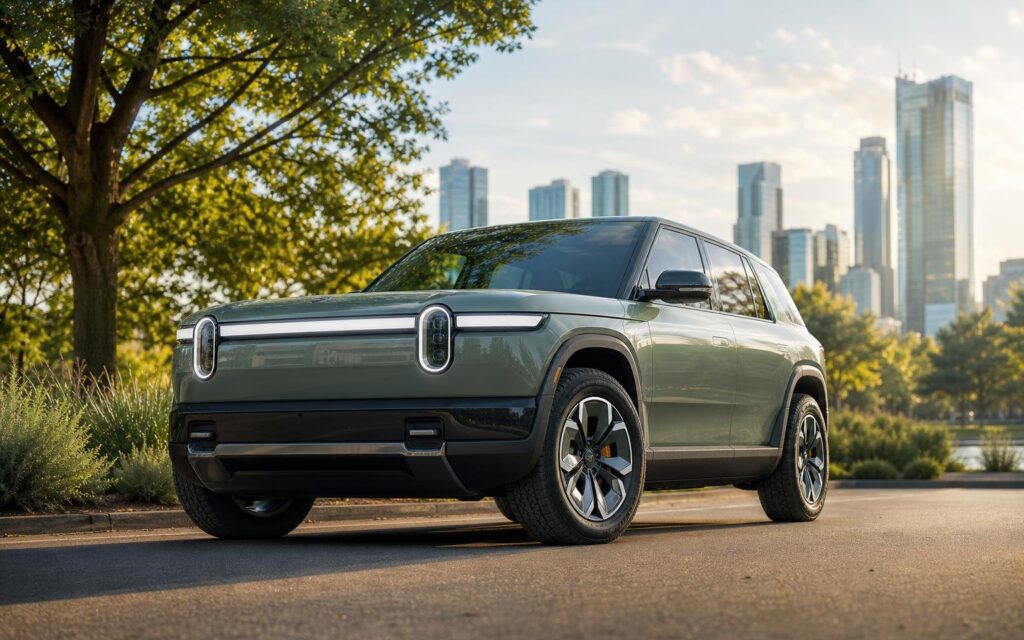
Rivian stock (NASDAQ: RIVN) has been one of the most closely watched electric-vehicle companies since going public. The stock has experienced enormous volatility, and the company still faces significant challenges on its path toward sustained profitability.
But the Rivian of 2026 looks considerably different from the company investors were evaluating just a few years ago.
The launch of the R2, improving gross margins, a major technology partnership with Volkswagen, expanding software revenue, growing autonomy ambitions and record vehicle deliveries are beginning to create a much broader investment thesis.
For investors willing to accept substantial risk and think five to ten years ahead, Rivian stock could represent an interesting long-term growth opportunity.
The R2 Could Change Everything
The most important development in the Rivian story is the R2.
Rivian’s original R1T pickup and R1S SUV established the company’s brand, technology and reputation, but they compete primarily in the premium end of the automotive market.
The R2 gives Rivian access to a much larger customer base.
Rivian began R2 deliveries in June 2026. The initial R2 Performance Launch Package starts at $57,990, with a Premium version starting at $53,990 scheduled for late 2026 and Standard versions starting below $50,000 planned for 2027.
That’s strategically important.
Rivian no longer needs to depend exclusively on consumers willing to spend premium-SUV money. The R2 allows the company to move toward the heart of the automotive market.
And early evidence suggests the strategy is gaining traction.
Rivian Just Delivered a Record Quarter
Rivian delivered 19,248 vehicles during Q3 2026, beating the roughly 18,000 expected by analysts and establishing a quarterly delivery record.
The company also produced 19,751 vehicles during the quarter.
Rivian maintained its full-year 2026 delivery forecast of 65,000 to 70,000 vehicles.
The significance goes beyond one quarter.
R2 deliveries only began in June. If Rivian can continue increasing R2 production over the next several years, the company’s addressable market could become dramatically larger than it was when its lineup consisted primarily of the R1T and R1S.
For long-term shareholders, R2 isn’t simply another model.
It could become the product that transforms Rivian stock from a niche premium EV manufacturer into a much larger automotive company.
The Economics Are Improving
Growth by itself isn’t enough.
Rivian eventually needs to demonstrate that it can manufacture vehicles profitably.
There are encouraging signs.
During Q2 2026, Rivian generated approximately $1.66 billion in revenue, representing 27% year-over-year growth.
More importantly, the company produced a record $179 million consolidated gross profit, equivalent to roughly an 11% gross margin.
There is an important caveat.
Rivian’s automotive segment still generated a $36 million gross loss during the quarter, while software and services generated $215 million of gross profit.
So investors shouldn’t interpret consolidated profitability as proof that Rivian has completely solved automotive profitability.
But the direction is encouraging.
Automotive gross profit improved dramatically from a $335 million loss during the comparable period a year earlier.
The R2 ramp now becomes critical.
If increasing R2 volumes improve manufacturing efficiency and spread fixed costs across more vehicles, Rivian’s automotive economics could look substantially different several years from now.
Volkswagen Validated Rivian’s Technology
One of the strongest parts of the Rivian investment thesis has little to do with selling Rivian-branded vehicles.
It’s Rivian’s technology.
Volkswagen and Rivian established their joint venture around Rivian’s electrical architecture and software technology, with Volkswagen planning investments of up to $5.8 billion in Rivian and the joint venture through early 2028.
Think about what that means.
One of the world’s largest automobile manufacturers decided that Rivian’s software and electrical architecture were valuable enough to form a multibillion-dollar strategic relationship around them.
That provides significant validation of Rivian’s technology.
It also opens an entirely different avenue for the company.
Rivian doesn’t necessarily have to make all of its future money from manufacturing Rivian vehicles.
Its technology could potentially generate value through software, services, licensing and partnerships with other manufacturers.
Software Could Become a Bigger Part of the Story
The difference between automotive and software economics is already visible.
Rivian generated $515 million of software and services revenue during Q2 2026, up 37% year over year.
That segment generated approximately $215 million of gross profit, representing a gross margin of roughly 42%.
Compare that with the enormous capital requirements involved in manufacturing automobiles.
Factories require billions of dollars.
Vehicles require materials, labor, batteries, logistics and enormous supply chains.
Software has a fundamentally different cost structure.
If Rivian can combine a growing automotive business with a higher-margin software and services operation, the company’s long-term economics could become considerably more attractive.
Rivian Is Also Becoming an AI and Autonomy Story
Rivian’s technology ambitions extend beyond infotainment.
The R2 represents what Rivian calls an “AI-defined vehicle.”
Rivian says the vehicle incorporates substantial onboard AI computing capabilities and hardware supporting its Autonomy+ platform. The company plans to offer hands-free assisted driving across millions of miles of roads in the United States and Canada, with additional point-to-point capabilities planned.
This creates another potential long-term opportunity.
Vehicles are increasingly becoming computing platforms.
The manufacturer capable of controlling the vehicle’s hardware, software, electrical architecture, user interface and autonomous-driving technology can potentially capture considerably more value over the life of the vehicle.
Rivian is attempting to build exactly that type of vertically integrated platform.
The Uber Relationship Adds Another Dimension
Rivian’s autonomy ambitions also received a significant boost through its relationship with Uber.
Under the long-term partnership announced in 2026, Uber agreed to invest up to $1.25 billion in Rivian, subject to milestones, with plans to begin deploying fully autonomous R2 vehicles through Uber’s network beginning in 2028.
It’s far too early to assume Rivian will become a major robotaxi company.
Autonomous driving remains technically difficult, heavily regulated and intensely competitive.
But the relationship creates another source of optionality.
Rivian could eventually have several businesses operating simultaneously:
Consumer EVs
Commercial vehicles
Automotive software
Technology licensing
Autonomy subscriptions
Robotaxi-related vehicles and services
That is a considerably broader opportunity than simply selling electric pickup trucks.
Rivian Still Has Significant Financial Resources
Building all of this will require enormous amounts of money.
Rivian ended Q2 with approximately $5.31 billion in cash, cash equivalents and short-term investments.
After incorporating its July equity offering, the company reported approximately $7.16 billion of pro-forma available liquidity.
Rivian also has potential access to additional capital connected with Volkswagen, Uber and the Department of Energy, although much of that funding depends on milestones and other conditions and therefore shouldn’t simply be treated as cash already sitting on Rivian’s balance sheet.
That liquidity matters because Rivian remains a cash-consuming business.
The company needs enough financial runway to ramp R2, expand production and continue developing future vehicles without placing excessive pressure on the balance sheet.
The Georgia Factory Could Support the Next Phase
R2 is only one part of Rivian’s longer-term product roadmap.
The company has also discussed the smaller R3 platform, which could eventually give Rivian another opportunity to reach consumers at lower price points.
Future production expansion—including Rivian’s planned Georgia facility—could therefore support a much larger vehicle portfolio.
This creates a potential progression:
R1 established the brand.
R2 expands the addressable market.
R3 could eventually take Rivian further into the mass market.
If that strategy succeeds, today’s production volumes could look relatively small compared with Rivian’s eventual manufacturing footprint.
That’s the long-term bet.
Rivian Has Built a Distinctive Brand
Automotive investing isn’t purely about manufacturing costs.
Brand matters.
Rivian has managed to establish a recognizable identity around adventure, technology, performance and premium design.
That’s difficult for a new automaker to accomplish.
The R1S and R1T gave consumers a clear idea of what a Rivian represents. R2 takes many of those characteristics and packages them into a smaller and more affordable vehicle.
If consumers continue associating Rivian with a distinctive combination of technology, capability and design, the brand itself could become a valuable competitive asset.
Why the Stock Remains Risky
None of this makes RIVN a guaranteed winner.
Rivian remains a speculative growth investment.
The company is still losing substantial amounts of money. Its automotive operation hasn’t yet demonstrated sustainable profitability. Building automobiles requires enormous amounts of capital, and future capital raises could dilute existing shareholders.
Competition is intense.
Tesla remains formidable. Traditional manufacturers are investing heavily in electric vehicles. Chinese EV manufacturers continue pushing technology and manufacturing costs lower globally.
Rivian also faces uncertainty surrounding EV demand, tariffs, government policy and consumer incentives.
Even after its record Q3 deliveries, management maintained its 2026 delivery outlook rather than raising it, disappointing investors who had expected stronger guidance.
That highlights an important distinction:
A great company doesn’t automatically equal a great stock at every price.
Valuation still matters.
The Bull Case for Rivian
The bullish Rivian thesis can be summarized relatively simply:
R1 builds the brand → R2 expands the market → greater volume improves manufacturing economics → software increases margins → Volkswagen expands the reach of Rivian technology → autonomy creates additional recurring-revenue opportunities → R3 potentially expands the market again.
If several of those pieces work, Rivian could eventually become much more than an EV manufacturer.
It could become an integrated automotive technology company.
That’s why the Volkswagen relationship may ultimately be just as important as vehicle deliveries.
It demonstrates that Rivian has potentially valuable intellectual property outside its own automobiles.
Why Rivian Could Be a Great Long-Term Buy
Rivian remains risky, but risk is precisely why the potential return can be substantial if the company succeeds.
The company now has something it didn’t have several years ago: evidence that its strategy is beginning to scale.
R2 is in customers’ hands.
Quarterly deliveries have reached a record.
Gross profit has improved substantially.
Software and services are generating meaningful gross profit.
Volkswagen is investing billions around Rivian’s technology.
Uber is backing Rivian’s autonomy ambitions.
And the company is working toward a broader lineup capable of reaching substantially more consumers.
The investment thesis therefore isn’t simply:
“Electric vehicles will become more popular.”
It’s more ambitious:
Rivian could evolve from a relatively small premium EV manufacturer into a scaled automotive and software platform.
If R2 continues gaining traction, automotive margins improve, software revenue expands and Rivian eventually reaches sustainable positive free cash flow, the business investors own five or ten years from now could look dramatically different from the company they see today.
That is what makes RIVN compelling as a speculative long-term investment.
Investors aren’t paying for certainty. There is very little certainty here.
They’re buying the possibility that R2 marks the beginning of Rivian’s transition from promising EV startup to scaled automotive technology company.
The next several years will tell us whether that transition succeeds.
Disclaimer: This article is for informational and educational purposes only and does not constitute investment advice. Rivian remains a speculative investment with significant operating, competitive, financing and execution risks. Investors should conduct their own research and consider their financial circumstances and risk tolerance before purchasing RIVN.