
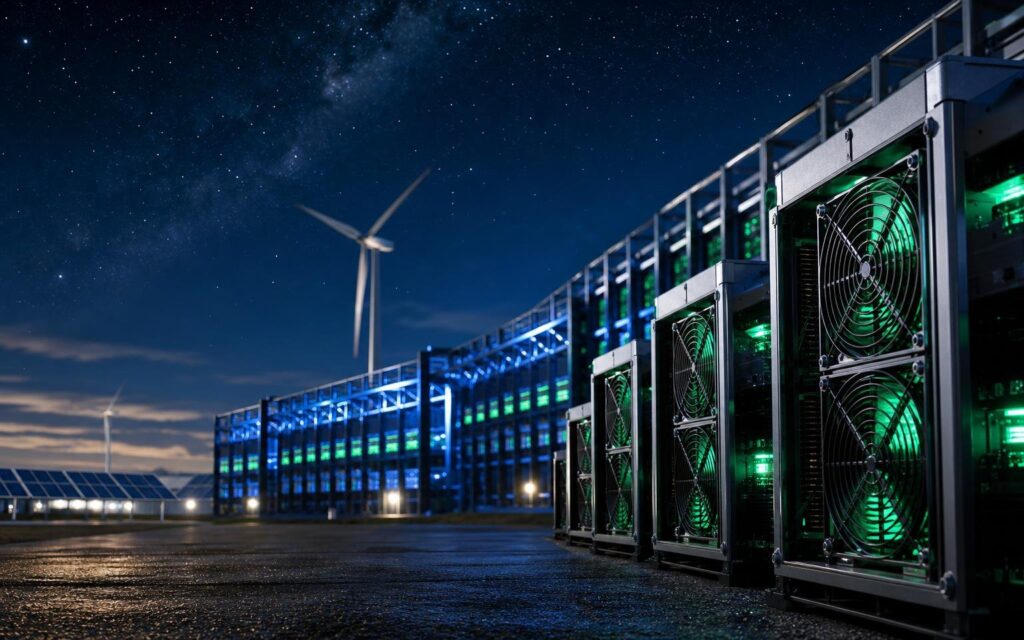
Hut 8 crypto revenue remains an important part of the story as Hut 8 rapidly evolves into an energy and AI infrastructure company. Bitcoin mining remains a potentially powerful source of revenue while its next generation of data centers comes online.
October 28, 2026 | RetailOptionTrader.com
When investors discuss Hut 8 today, the conversation increasingly revolves around artificial intelligence.
That’s understandable.
Hut 8 is developing enormous data-center projects.
It has secured long-term AI infrastructure agreements.
It controls significant power capacity.
And management increasingly describes Hut 8 as an energy infrastructure platform rather than simply a Bitcoin miner.
But I think there’s a danger in moving too quickly past the company’s original business.
Hut 8 crypto revenue still matters.
In fact, Hut 8’s Bitcoin-related operations may be more meaningful today precisely because the company is expanding into AI.
Hut 8 crypto revenue can contribute while the company develops its next generation of data centers.
It can monetize energy infrastructure that already exists.
It gives Hut 8 continued exposure to Bitcoin.
And it demonstrates that the company’s power assets can be transformed into economically valuable computing capacity.
That’s why I don’t look at Hut 8’s crypto operation as an outdated business that investors should ignore.
I look at it as one component of a much larger infrastructure strategy.
1. Hut 8 Is Still Generating Significant Compute Revenue
Let’s begin with the numbers.
During the second quarter of 2026, Hut 8 reported:
$74.9 million in total revenue.
Of that amount:
$72.5 million came from Compute.
That means the overwhelming majority of reported quarterly revenue came from the Compute segment, which includes ASIC Compute alongside AI Cloud and Traditional Cloud.
A large driver was Bitcoin mining.
In Q2 2026, Hut 8’s consolidated operations mined approximately:
935 Bitcoin.
During Q2 2025, the comparable number was only approximately:
308 Bitcoin.
That’s a massive increase in production.
And it translated directly into higher revenue.
Compute revenue increased from:
$34.3 million
to:
$72.5 million.
That’s an increase of approximately:
111%.
For investors focused exclusively on Hut 8’s future AI opportunity, those numbers are worth remembering.
The company’s crypto-related compute operation isn’t merely a legacy business sitting in the background.
Hut 8 crypto revenue is meaningful today.
2. The First Half of 2026 Makes the Growth Even Clearer
Looking at six months rather than one quarter makes the trend even more interesting.
During the first six months of 2025, Hut 8 generated approximately:
$50.4 million in Compute revenue.
During the first six months of 2026:
$138.4 million.
That’s an increase of roughly:
$88 million.
Bitcoin production increased dramatically as well.
During the first half of 2025, Hut 8’s consolidated operations mined approximately:
420 Bitcoin.
During the first half of 2026:
1,752 Bitcoin.
That’s more than four times as much Bitcoin production.
And here’s what I find particularly interesting:
The growth occurred even though the average revenue recognized per Bitcoin mined declined.
In other words, Hut 8 didn’t need a higher Bitcoin price to produce the revenue increase.
It produced considerably more Bitcoin.
That’s an important distinction.
3. How Production Capacity Supports Hut 8 Crypto Revenue
Mining economics depend on several variables.
Among them:
Bitcoin price
Network difficulty
Hashrate
Energy costs
Mining-machine efficiency
and
Operating uptime.
Hut 8 can’t control every one of those variables.
But it can control infrastructure and execution.
The company’s increased 2026 production was driven partly by additional operating capacity.
The Vega site began ASIC Compute operations in 2025.
Drumheller was re-energized in March 2026.
Hut 8 also benefited from improved uptime following fleet upgrades at Salt Creek and Medicine Hat.
That’s meaningful because Hut 8 crypto revenue isn’t simply:
Bitcoin price goes up = Hut 8 makes more money.
There’s another lever:
Produce more Bitcoin efficiently.
Hut 8 has been pulling that lever.
4. Bitcoin Mining Converts Electricity Into a Digital Asset
At its simplest level, Bitcoin mining is an energy-conversion business.
Hut 8 has access to:
Power
Land
Electrical infrastructure
Data-center facilities
Mining equipment
and
Computing capacity.
Mining allows the company to convert those resources into Bitcoin, helping generate Hut 8 crypto revenue.
The basic economic chain looks like:
Electricity → computing power → Bitcoin production → revenue
That’s why power is so important to the Hut 8 thesis.
The company isn’t merely buying Bitcoin and hoping the price rises.
It operates infrastructure capable of producing Bitcoin.
That distinction matters.
5. Hut 8’s Real Competitive Advantage May Be Power
This is where the crypto and AI stories begin to connect.
Bitcoin mining requires enormous amounts of electricity.
AI data centers also require enormous amounts of electricity.
That means both businesses compete for one increasingly valuable resource:
Power capacity.
Hut 8 spent years learning how to acquire, develop, operate, and monetize energy-intensive computing infrastructure.
Bitcoin mining helped build that expertise.
Now the same organizational capabilities can potentially be applied to AI infrastructure.
That’s why I don’t think investors should view:
Bitcoin mining
and
AI data centers
as completely unrelated businesses.
They’re different applications of a similar underlying infrastructure platform.
6. Bitcoin Mining Helped Hut 8 Build the Platform
Imagine trying to build an AI data-center company from scratch.
You need:
Land.
Power.
Transmission infrastructure.
Utility relationships.
Substations.
Engineering expertise.
Data-center operations.
Capital.
And experience managing energy-intensive computing equipment.
Hut 8 didn’t begin from zero.
Bitcoin mining gave the company years of experience operating large-scale compute infrastructure.
Now Hut 8 can attempt to move portions of its platform toward potentially longer-duration and lower-cost-of-capital businesses such as AI data centers.
Bitcoin mining helped create the foundation.
7. Hut 8 Crypto Revenue Can Bridge the Gap to AI Revenue
This may be the most important part of my thesis.
Hut 8’s AI opportunity is enormous.
But enormous infrastructure projects take time.
Data centers need to be:
Designed
Financed
Constructed
Energized
Commissioned
and
Delivered to customers.
That process can take years.
Hut 8’s major River Bend and Beacon Point projects aren’t simply producing their full future contracted economics today.
They’re under construction.
Bitcoin mining, meanwhile, is already operating.
That means Hut 8 crypto revenue can serve as part of the economic bridge between:
Hut 8 today
and
the much larger AI infrastructure company management is trying to build.
8. Hut 8’s AI Opportunity Is Already Massive
The scale of the future business is important for context.
As of Q2 2026, Hut 8 reported approximately:
949 MW of contracted AI data-center IT capacity.
The company said those contracts represented approximately:
$26.6 billion in expected aggregate base-term contract value.
Management also estimated more than:
$1.75 billion in expected average annual NOI
from contracted AI data-center capacity.
And Hut 8 had secured approximately:
$7.5 billion of investment-grade project financing.
Those numbers are dramatically larger than the company’s present quarterly mining revenue.
That’s why investors are excited about AI.
But it also highlights why Hut 8 crypto revenue matters today.
The mining business helps give Hut 8 an operating business while the larger infrastructure opportunity develops.
9. Hut 8 Doesn’t Have to Choose Bitcoin or AI
I think investors sometimes create a false choice.
Either Hut 8 is:
A Bitcoin miner
or
An AI data-center company.
Why can’t it be both?
Different power assets may have different optimal uses.
One site might be appropriate for:
Bitcoin mining.
Another might be better suited for:
AI infrastructure.
Another might support:
Traditional cloud computing.
Another could potentially generate:
Power-related revenue.
The ability to allocate energy infrastructure toward different economic uses could ultimately become one of Hut 8’s biggest advantages.
10. Bitcoin Mining Can Be Flexible
This flexibility matters because Bitcoin mining workloads differ from many traditional data-center workloads.
A major enterprise customer expects its computing infrastructure to remain available.
Bitcoin miners can sometimes operate more flexibly around energy-market conditions.
That can create opportunities for sophisticated power management.
If electricity becomes unusually expensive, the economics of running miners change.
If power becomes inexpensive, mining may become more attractive.
That flexibility can potentially make mining useful within a broader energy-management strategy supporting Hut 8 crypto revenue.
11. The Bitcoin Treasury Matters Too
Hut 8 crypto revenue is only one part of its Bitcoin exposure, which doesn’t end when the mining reward is produced.
The company also carries substantial Bitcoin exposure through its consolidated balance sheet, including holdings associated with its broader corporate structure and American Bitcoin.
At June 30, 2026, Hut 8 reported:
17,316 Bitcoin held.
The carrying value was approximately:
$1.04 billion.
That creates a second economic dimension.
Hut 8 can potentially benefit from:
Bitcoin production
and
Bitcoin appreciation.
But this works both ways.
When Bitcoin declines, Hut 8 can report substantial mark-to-market losses.
That happened during Q2 2026.
12. The Q2 Net Loss Shows Why Investors Need to Understand the Accounting
Hut 8 reported a Q2 2026 net loss of approximately:
$177.1 million.
At first glance, that looks terrible.
But the quarter included approximately:
$138.6 million of primarily unrealized losses on digital assets.
Bitcoin declined substantially during the quarter.
As a result, the accounting value of Hut 8’s digital assets fell.
That loss flowed through the income statement.
This is important because investors need to distinguish between:
Operating performance
and
Bitcoin mark-to-market movements.
Hut 8’s operating revenue increased substantially even while falling Bitcoin prices created a large accounting loss.
Both matter.
But they’re not the same thing.
13. Adjusted EBITDA Improved
Hut 8 reported Q2 2026 Adjusted EBITDA of:
$10.4 million
compared with:
$4.2 million
during the prior-year quarter.
The company changed its presentation so its main Adjusted EBITDA measure excludes mark-to-market gains and losses on digital assets.
I think that’s useful.
Bitcoin can move dramatically in a single quarter.
Those movements can make the income statement look extraordinarily strong or extraordinarily weak.
Separating operating performance from mark-to-market Bitcoin movements can give investors another way to evaluate the underlying business.
14. Hut 8 Crypto Revenue Can Scale With Mining Capacity
Bitcoin mining has an interesting economic characteristic.
Once infrastructure exists, additional productive capacity can have a substantial impact on revenue.
We saw this during Q2.
Hut 8’s consolidated Bitcoin production increased from approximately:
308 BTC
to:
935 BTC.
Compute revenue increased from:
$34.3 million
to:
$72.5 million.
The company effectively demonstrated how additional operating capacity can translate into significantly higher revenue.
That’s meaningful.
15. Bitcoin Price Still Matters Enormously
None of this means Hut 8 crypto revenue has escaped Bitcoin-price risk.
Far from it.
Hut 8 itself acknowledges that its current financial results remain heavily dependent on Bitcoin’s price.
That’s logical.
Imagine Hut 8 mines:
1,000 Bitcoin.
At $50,000 per Bitcoin, those coins represent:
$50 million.
At $75,000:
$75 million.
At $100,000:
$100 million.
At $150,000:
$150 million.
Same Bitcoin production.
Completely different revenue economics.
That’s why Bitcoin miners can exhibit enormous operating leverage to the price of Bitcoin.
16. The Reverse Is Also True
Leverage works both ways.
If Bitcoin falls dramatically while:
Energy prices rise
Network difficulty increases
or
Mining equipment becomes less efficient,
profitability can deteriorate quickly.
That’s why I wouldn’t value Hut 8 simply by multiplying Bitcoin production by an aggressive future Bitcoin-price target.
Mining remains a competitive commodity-like business, so Hut 8 crypto revenue comes with ongoing operating risks.
Economics can change.
17. Network Difficulty Matters
Bitcoin has a fixed issuance structure.
Miners compete with one another for block rewards.
As more computing power joins the network, competition increases.
That means Hut 8 can improve its own mining fleet and still face pressure from increasing global hashrate.
This creates a constant technological race.
Efficient miners need:
Modern equipment
Low-cost power
Strong uptime
and
Disciplined capital allocation.
Simply owning mining machines isn’t enough.
18. The Halving Matters Too
Bitcoin periodically reduces the block subsidy miners receive.
This is known as the halving.
After each halving, miners receive fewer new Bitcoin per block, all else being equal.
That can pressure weaker operators.
But it can also strengthen the competitive position of companies with:
Lower power costs
Better machines
More efficient operations
and
Access to capital.
The mining industry tends to reward efficiency.
That’s why Hut 8’s broader infrastructure strategy matters.
19. American Bitcoin Adds Another Dimension
Hut 8’s mining strategy has also evolved through American Bitcoin.
Rather than thinking about Hut 8 purely as a conventional miner, investors increasingly need to understand a broader corporate ecosystem involving:
Power infrastructure
Mining
Bitcoin accumulation
Data centers
and
AI computing.
That structure makes the company more complicated.
But it also creates multiple potential sources of value.
20. Hut 8 Crypto Revenue Gives the Company Optionality
This is the word I keep coming back to:
Optionality.
Suppose AI infrastructure becomes enormously valuable.
Hut 8 can continue developing AI campuses.
Suppose Bitcoin enters another major bull market.
Its Bitcoin-related operations and holdings can benefit.
Suppose power capacity itself becomes increasingly scarce.
Hut 8 owns and develops infrastructure connected to that resource.
Instead of depending on one economic outcome, Hut 8 has exposure to several.
That’s why the company is becoming more interesting.
21. Bitcoin Mining Is No Longer the Entire Thesis
This is another important distinction.
Several years ago, an investor might evaluate Hut 8 primarily by asking:
How much Bitcoin can it mine?
Today I would ask a much broader set of questions:
How much power does Hut 8 control?
How much capacity can it develop?
How much Bitcoin can it produce?
How efficiently can it produce it?
How much AI capacity can it contract?
How quickly can it construct data centers?
How much financing can it secure?
Who are the counterparties?
And how much recurring infrastructure income can those assets eventually produce?
That’s a much more sophisticated investment thesis.
22. How Hut 8 Crypto Revenue Can Contribute to Funding Needs
Infrastructure development is expensive.
Building gigawatt-scale data centers requires enormous capital.
Hut 8 has secured substantial project financing for its AI developments, which is important.
But having an existing operating business generating Hut 8 crypto revenue is still valuable.
Every dollar generated internally can potentially support:
Corporate operations
Development activities
Investment
Debt service
or
future growth.
Mining doesn’t need to fund the entire AI buildout to be economically meaningful.
It simply needs to contribute.
23. The Revenue Mix Will Probably Change
Today, Compute dominates Hut 8’s reported revenue.
That may not always be true.
If Hut 8 successfully delivers its contracted AI data-center campuses, the company’s revenue and cash-flow profile could eventually shift dramatically.
The future mix could increasingly include:
Long-term AI infrastructure revenue
Bitcoin-related compute revenue
Digital infrastructure
and
Power-related economics.
That transition could make Hut 8 less dependent on Bitcoin over time.
Ironically, that could make its Bitcoin exposure more attractive.
Why?
Because Bitcoin would become one source of upside rather than the only source of value.
24. That’s the Hut 8 Story I Find Most Interesting
I’m not interested in Hut 8 simply because:
Bitcoin might go up.
If that were my only thesis, I could simply buy Bitcoin.
The more interesting thesis is:
Hut 8 has spent years developing power and compute infrastructure through Bitcoin mining, and that infrastructure may now position it to participate in one of the largest computing buildouts in history.
Bitcoin mining helped build the platform.
Hut 8 crypto revenue helps monetize the platform today.
AI could dramatically expand the platform tomorrow.
That’s a much more compelling story.
25. What I Would Watch Going Forward
There are several numbers I would monitor.
Bitcoin Production
Is consolidated production remaining strong?
Compute Revenue
Can Hut 8 crypto revenue remain meaningful as the company develops its AI business?
Cost of Revenue
Revenue means less if mining costs rise faster.
Bitcoin Price
Hut 8 remains exposed to Bitcoin’s volatility.
Development Progress
Are River Bend and Beacon Point staying on schedule?
Contracted AI Capacity
Can Hut 8 continue converting its development pipeline into long-term contracts?
Financing
Can projects continue to be financed without excessive dilution or parent-level financial risk?
Adjusted EBITDA
Is operating performance improving independently of Bitcoin mark-to-market movements?
These metrics will tell us whether Hut 8 is successfully transitioning from a Bitcoin miner into a broader energy and computing infrastructure company.
The Bottom Line
I believe Hut 8 crypto revenue remains meaningful.
Not because Bitcoin mining is necessarily the company’s ultimate destination.
But because it’s helping support the journey.
During Q2 2026, Hut 8 generated approximately:
$72.5 million in Compute revenue.
Consolidated Bitcoin production reached approximately:
935 BTC.
During the first six months of 2026, Compute revenue reached approximately:
$138.4 million.
And consolidated Bitcoin production reached approximately:
1,752 BTC.
Those aren’t insignificant numbers.
They’re evidence that Hut 8 still has a substantial operating business while its much larger AI infrastructure strategy develops.
At the same time, Hut 8 has assembled:
949 MW of contracted AI data-center capacity
with approximately:
$26.6 billion of expected aggregate base-term contract value
and more than:
$1.75 billion of expected average annual NOI.
That creates an unusual combination.
Bitcoin provides revenue today.
AI infrastructure could provide enormous contracted economics tomorrow.
And underneath both businesses sits the resource that may ultimately be most valuable:
Power.
That’s why I don’t view Hut 8 as simply another crypto miner.
I view it as an energy and computing infrastructure company that currently has a meaningful Bitcoin revenue engine.
If management executes successfully, Bitcoin mining doesn’t have to disappear for the AI thesis to work.
The two businesses can coexist.
And that may ultimately be one of Hut 8’s biggest advantages.
Disclaimer: This article is for educational and informational purposes only and does not constitute investment, financial, tax, or options-trading advice. Hut 8 remains exposed to substantial risks including Bitcoin-price volatility, mining difficulty, energy costs, digital-asset mark-to-market fluctuations, development and construction risk, financing risk, customer concentration, leverage, dilution, and execution risk. Expected AI contract values and NOI are forward-looking company estimates and should not be treated as guaranteed future revenue or profit.